

It often comes out of nowhere. Someone is sitting across from me, talking about something else entirely, and they stop mid-sentence. They've just realised that for years they haven't done something they used to love. Not since that person they did it with died. They never decided to stop doing it. It just quietly fell away, and they didn't notice it going until that moment.
I see this a lot, and it gets me every time. Partly because of what it says about grief, and partly because I personally recognise it. What's being described isn't just grief for a person. It's grief for a whole part of their life that went with them.
In the last piece, I wrote about fixed points, the people we quietly steer by. This one is about what happens when one of them goes.
The quiet closing off
When we lose someone, we often lose the things and experiences that we shared with them too. The walk you always did together. The programme you watched. The trip you took every year. Sometimes we step away because going back simply hurts too much. Being there without them makes that void impossible to ignore.
But sometimes it isn't just that it hurts. It's that it doesn't mean anything any more. What made the activity matter was never really just the activity. It was the connection it held. The Sunday walk was never really about the walk, and the programme was never really about the programme. They were the excuse, the thing you did so you could be together. Take the person away and you're left doing the excuse on your own, and it turns out there was never much to it without that person.
Either way, our world gets a little smaller, one avoided thing at a time, and we rarely see it happening.
The overprotective mam
I want to highlight that closing things off after a loss isn't weakness, and it isn't doing grief wrong. It's a part of our mind doing its job. Our minds are very good at steering us away from pain, and it doesn't ask permission first, just like it never asks permission when it presents its pain to the surface.
It's a bit like an overprotective mam. The kind who won't let you out in case you catch your death and wants to wrap you in bubblewrap. Well meaning, possibly right more often than we'd like to admit, but let her run things forever and you'll never leave the house and you'll never experience what life has to offer..
The places we avoid often hold joy as well as pain. Now that's not a reason to force ourselves back through the door, but it is a reason to notice the door is actually there.
Where the lights used to be
So what are we really grieving? The person, of course. But also who we were with them, our experience of the world with them and our sense of where we stood.
My dad died nine years ago. Of course I'd always known that he mattered. What I hadn't understood, until he was gone, was how much I steered by him. I didn't ring him about every decision. I didn't need to. In my head, though, I turned to him for nearly all of them. Career moves. Relationships. Every choice, big and small. Every question I ever had. I'd run it past him without even noticing I was doing it.
He was my lighthouse, my reference point that gave my whole life some sense of direction and safety. I know that's a bit on the nose coming from a man who named his business after one, but there it is.
And then there were the cuppas. Round at his and my mam's, sat at the table, putting the world to rights. Politics, whatever was on the news, whatever was going on anywhere. We disagreed as often as we agreed, sometimes more. But even when we were disagreeing, we were together. I didn't know at the time that those arguments were some of the closest we ever got.
In our family, the joke was that my dad was the silverback. He wasn't a tall man, short and stocky if anything, but he was strong as anything, with these huge hands like an ape's. He'd sit at the head of the table with them laid flat in front of him, turned outward, and between the two of them they covered nearly the whole width of it. Nobody needed telling who was at the head of that table.
After he died, I'd go to ask him something and there was nobody there. Not just nobody to ring, but nobody in my head, either, or at least nobody who answered. It wasn't only sad. It was disorientating, like looking up for the one light you've always steered by and finding the sky empty.
I once heard Jordan Peterson say that you should aim to be the strongest person at your father's funeral. I think there's something old in that, almost primal. We say goodbye to our grandfathers, then our fathers, and one day we look round and realise the seat at the head of the table is ours. I didn't understand it when I first heard it. I do now. When that fixed point goes, there's nobody left above you to steer by. Nobody tells you how lonely it is at the head of the table.
Walking up into the stadium
My dad had his seat at the Stadium of Light from the day it opened in 1997. Before that it was Roker Park, where he took me as a kid. If that doesn't tell you something about the man's loyalty, and his capacity for suffering, nothing will. Those winter days with the whole of the North Sea blowing in your face and hailstones hitting you from every angle. Going to the match was our thing. It was where we were most ourselves together, father and son without a worry in the world.
Near the end, when he was too ill to go, I sat in his seat for him. That was hard enough. Every time, I was sitting where he should have been, and we both knew why he wasn't.
After he died, I asked the club if I could keep his seat. They were great and of course said yes. I guess they knew it would be a guaranteed season ticket sale until I was no longer here.
The first match back, I parked where we always parked, walked the way we always walked, and grabbed a burger from the same van we always used (but now I had to pay). The same streets, the same crowd heading the same way. It felt wrong. Not sad exactly. Wrong. As if I'd forgotten something and kept reaching for it. The whole thing felt emptier, less than it used to be, and I couldn't have told you why it should feel less when everything around me was exactly the same.
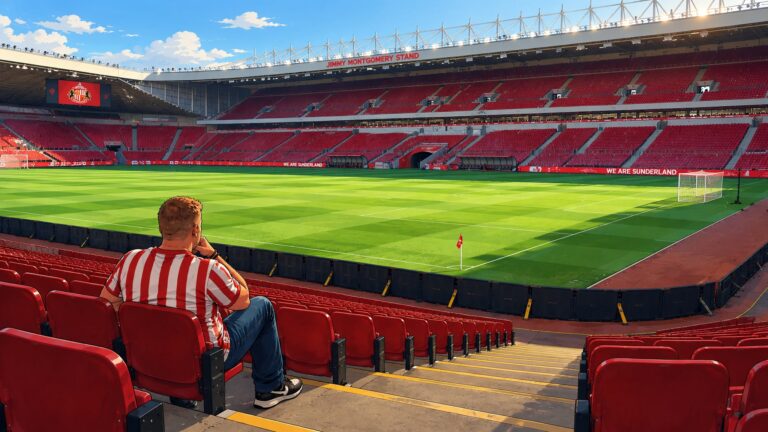
There's a moment at every match, and it's been the same since I was a kid at Roker Park. You walk up to the stadium, through the turnstile, and then up through the access point and the stadium opens out in front of you. The noise, the pitch, the size of it. It always hits me. It was a moment we both knew, without saying a word, that we were both part of something special. Him and me, and all of it.
That day, it became the hardest part. That something special was still there. He wasn't.
Then I walked down to his seat. The same people had sat around him for years and years. Steve, who'd brought his son Dan since he was tiny. Lisa in the row in front, who could always make my dad laugh with the miniatures that she smuggled in. We've never really spoken outside of football. We don't need to. That's where we know each other. That's our place.
They all looked up at me, and I could see they already knew what I'd come to tell them. I didn't have to say it. The look on their faces said everything about what he'd meant to them. I'd thought of the seat as ours, his and mine. Standing there, I realised it belonged to all of them a bit as well. They'd lost him too.
I sat down. Surreal is the only word I've got for it. Nearly thirty years of that seat now, twenty of them his. That first day, it didn't feel like it belonged to either of us. I was sitting in the right place, and I've never felt more lost.
Something to sit with
I want to say something plainly here, because when you're in the middle of grief it's easy to feel you're getting it wrong. Steering clear of places you used to love. Feeling lost somewhere that always felt like home. Reaching for someone in your head and finding nobody there. None of that means something is wrong with you. It isn't a disorder to be fixed, and there's no timetable you're falling behind on.
It's what happens to people who let someone matter. We don't build our lives on our own. We build them out of other people, and when one of them goes, part of the map goes with them. Feeling lost after that isn't a sign you're coping badly. It's a measure of how much they meant to you. It's about as human as it gets.
So if you've lost someone, it might be worth asking yourself, gently, who you still turn to in your head, even now. And who else lost them too. The people who sat around them, in whatever form that took, might be carrying some of the same gap. Sometimes they're the only ones who know exactly what's missing.
In the last piece in this series, I want to come back to that seat, and to what happened when I kept going back.
