

On Monday I watched the Prime Minister look down a camera and promise to give children their childhood back. A ban on social media for the under-16s. A line in the sand. The tech giants had their chance and they failed. It was a good piece of theatre, and like most good theatre it worked because it handed everyone a villain to point at and the feeling that something, at last, was being done.
You might remember Mia from the last time I wrote about this. The hyperthetical fourteen-year-old in my therapy room, the cracked phone in her lap that I called a teddy bear, the thing she clutched in the dark rather than the thing doing the harm. I stand by all of it. But this week the proposal became a policy, and a new number is being waved about to justify it. I want to talk about the number, because the number is where the trick lives.
Here it is. The government ran a consultation, got more than 116,000 responses, and we are told over 90 per cent backed the ban. Case closed. The public has spoken.
Except a consultation is not what most people think it is. It is not a poll. Nobody knocked on a representative sample of doors. A consultation is open to anyone with a view, which means it gets filled in by the people who already hold a strong view or even a secret agenda. It measures the loudness of the motivated, not the balance of the nation. And this one was loud by design. It was promoted through MPs, influencers and schools, fired up by a well-organised campaign from the advocacy group Smartphone Free Childhood, and ended up the second-largest consultation response in British history. That is not neutral reach. That is a mobilisation.
Then there is the 90 per cent itself, which turns out to be a parents’ figure, not a children’s one. When you read what the children actually said, the picture softens considerably. Two-thirds of them supported some restrictions on some platforms, which is a long way from a blanket ban. Forty per cent of children in the consultation said the benefits outweighed the risks. And asked what they wanted protecting from, they named specific things: explicit images, contact from strangers, livestreaming. The young people the policy is supposedly for asked for targeted safety. The adults around them asked for a wall. Guess which one got the press conference.
There was even a question asking whether adults should do more age checks “if it means children are safer online.” Ask it like that and of course people say yes. Who in their right mind would actually say no to this.
I am not telling you this to defend social media. I am telling you because it is the same move I keep writing about. Locate the distress in one removable thing, declare war on the thing, and you never have to look at the conditions underneath. We did it with the chemical imbalance and the antidepressant. We are doing it now with the diagnosis. And here it is again, dressed as protection, with a consultation standing in for consent. A government that bans an app gets to look decisive. A government that funds CAMHS properly, or confronts child poverty, or asks what testing and insecure work are doing to families, has to spend money and admit fault. One of those is a great deal cheaper than the other.
The deepest part of this, though, I owe to someone else, and I will admit, with some irony, that I found it on TikTok. Catherine Knibbs, a trauma psychotherapist who has spent years working with the genuine harm done to children online, made a point that reorganised my thinking. We keep treating social media as if it were a substance, she said. A toxin to be prohibited, like a drug. But it is not a substance. It is an environment. And you do not ban an environment because harm happens inside it.
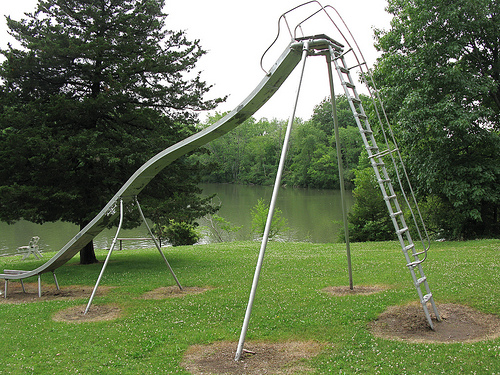
Think about the playground. It used to be a place where children broke arms on concrete and fell from heights with nothing underneath them. We did not ban the playground. We put guardrails on the climbing frame, softened the ground, kept a watchful eye via cctv. We made the environment safer, because we understood that children need somewhere to play, and that the answer to danger in a place is to make the place less dangerous, not to lock the gate.
This matters precisely because Knibbs is no apologist. She has seen the worst of what these spaces do, and even she is saying the framing is wrong. The harm is real, but it lives in specific features and specific design choices: the infinite scroll, the algorithm that learns your insecurities, the stranger who can message a child. Those are the concrete and the missing railings. Ban the whole environment and you have not removed the harm. You have only moved the children somewhere you cannot see them, which is exactly what Meta and YouTube warned would happen when they said a blanket ban would push young people into the unregulated corners of the internet. For once the tech companies and the trauma therapist agree, and the government is listening to neither.
So I keep coming back to the same quiet question. When we are told the country has already agreed, that 90 per cent are behind it, that the public has spoken, it is worth asking who counted, who was asked, and who benefits from us believing the argument is over. Because the children, when you actually read their words, were asking for something far more careful than a wall. I wonder what would happen if, just once, we built them the safer playground instead.
